

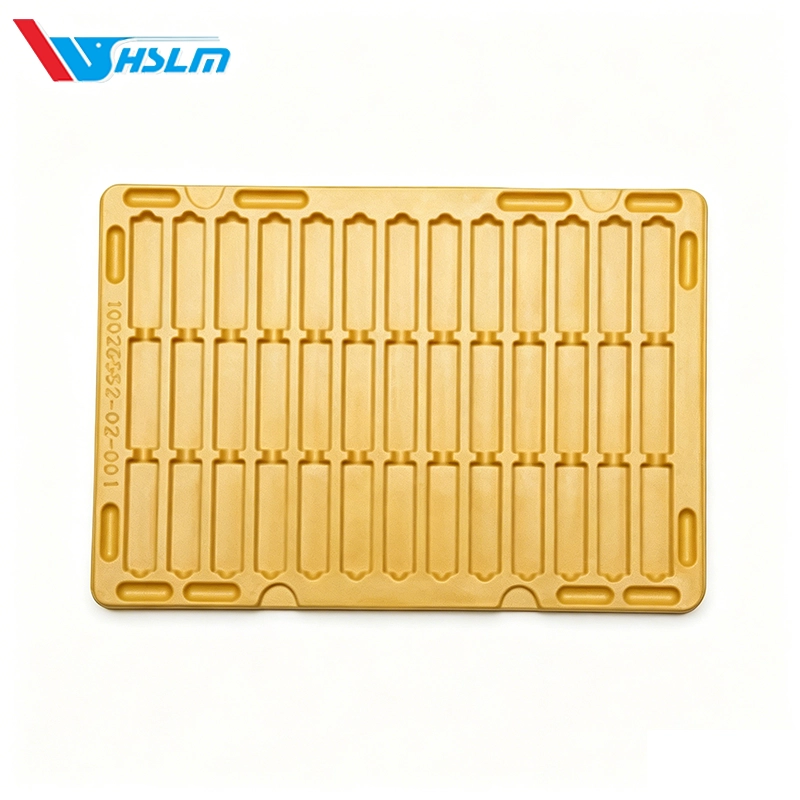
Gold anti-static multi-slot tray for electronics. Static-proof, scratch-resistant, stackable and customizable.
This gold anti-static multi-cavity electronic tray is made of static dissipative plastic to shield sensitive electronic parts from electrostatic damage. Independent molded slots separate components to avoid friction and scratches in circulation. Rigid stackable structure reduces storage space, and custom sizes, cavity layouts and thickness can be tailored for various precision electronic accessories.
- 1 Permanent & Stable ESD Protection
- 2 Precision CNC Tool-Molded Pockets
- 3 100K Cleanroom Certified Hygiene
- 4 High-Density Space-Saving Nesting
Gold antistatic multi cavity electronic tray is part of our Thin-Gauge Precision Trays line. The series-level introduction, specifications, applications and FAQ below apply to this model and its related sizes. Custom specifications, materials and branding are available for bulk orders.
Product Overview & Market Intent
Microelectronics, semiconductor and high-end electronics assembly all place the same demand on packaging: the component must not move, and the surface must not carry a charge. gold antistatic multi meets both, and holds its geometry across automated handling, plant transfer and long-haul freight.
The trays are produced in a 100,000-class dust-free cleanroom by a team with over twenty years of OEM/ODM experience. Sheet selection spans anti-static, dissipative and conductive formulations in PS, PET and PVC, and every cavity is cut to a micro-tolerance band that keeps it compatible with automated handling.
Key Product Characteristics
Permanent & Stable ESD Protection (Zero Electrostatic Risk): The anti-static properties are deeply embedded into the plastic sheet matrix, securing long-term stable resistivity (10^6 – 10^9 Ohm for dissipative or 10^3 – 10^5 Ohm for conductive) that won’t fade due to friction, washing, or environmental humidity changes.
Precision CNC Tool-Molded Pockets: Utilizing high-precision CNC tooling, each pocket/cavity is engineered with precise draft angles and tolerances, securing components stay snugly in place without friction damage while allowing rapid mechanical grabbing.
100K Cleanroom Certified Hygiene: Free from airborne dust, oils, or lint fibers, securing that sensitive electronic sensors, lenses, and acoustic parts are protected from microscopic surface contamination.
High-Density Space-Saving Nesting: In the empty state, these thin-walled trays nest cleanly together with minimum clearance, substantially lowering warehouse storage footprint and reducing international ocean freight costs per unit.
On ESD-sensitive lines running gold antistatic multi, hardware & Fine Instrument Storage: Serves as precision custom-slotted storage inserts for multi-part toolkits, micro-screws, and calibration tools in assembly bays. Commercial Applications & Scenarios Automated PCBA & Semiconductor Shipping: Serves as the standardized carrying tray matrix for raw circuit boards, microchips, and motherboard modules passing through high-speed SMT assembly lines. Consumer Electronics & Earphone Inner Liners: Tailored sleek black or custom-colored thin-gauge blister inserts used inside retail packaging for high-end earphones, smartwatches, and smartphone accessories to boost shelf presence. Fragile Medical Electronics Components: Provides secure, clean-room approved compartmentalized tray packaging for precision laboratory sensors and dental equipment pieces.
Technical Specifications
Technical Detail & Industrial Standard: Product Category
ESD Blister Trays / Thin-Gauge Electronic Packaging / Vacuum Formed Inserts: Material Formulation
High-Grade PS (Polystyrene), PET, PVC (Virgin Clear or Solid Matte Finishes): Material Thickness Range
Thin-Gauge Options: 0.5mm, 0.8mm, 1.0mm, to 1.5mm
Conductive: 10^3 – 10^5 Ohm | Dissipative: 10^6 – 10^9 \Ohm$ | Anti-Static: 10^9 – 10^{11} \Ome$
Production Environment: 100,000-Class Dust-Free Cleanroom Production Lines
Core Compliance: RoHS Compliant, REACH Certified, Lead-Free, SGS Laboratory Tested
Customization Capability: Full Custom CAD/3D Sample Engineering, Engraved Part Numbers & Logos
Global Industrial Case Study
The Client: A manufacturer shifting a packaging line from manual to automated handling.
The Challenge: The existing packaging was dimensionally inconsistent, so the denester jammed and the line ran at a fraction of its rated speed.
Our Solution: We tightened the critical dimensions and supplied a trial run of the revised specification so the customer could prove the format on the line before the changeover.
The Outcome: The jamming stopped, the line reached its rated speed, and the customer standardised on the revised specification across the site.
B2B Frequently Asked Questions
Q1: How do dissipative and conductive versions of gold antistatic multi differ in practice?
A: The distinction is the surface resistivity band, not the base resin. Conductive grades sit at 10^3 – 10^5 Ohm and drain a charge almost instantly; dissipative grades sit at 10^6 – 10^9 Ohm and bleed it off in a controlled way. Which one you need depends on how sensitive the device is and how fast your line moves.
Q2: Is gold antistatic multi produced in a controlled cleanroom environment?
A: All static-control trays are moulded, trimmed and packed inside a 100,000-class dust-free area. Airborne dust, oil mist and lint are the main sources of latent field failures on fine-pitch components, and controlling them at the point of packing is cheaper than screening for them later.
Q3: What do you need from us to tool a custom cavity layout for gold antistatic multi?
A: Send a physical sample or a STEP file and our engineering desk returns a cavity layout, draft angles and a 3D-printed fit check. You approve the fit before we cut metal, which keeps tooling risk on our side rather than yours.
Q4: Do the anti-static properties of gold antistatic multi fade with age or repeated washing?
A: No. The anti-static compound is blended into the sheet matrix rather than coated onto the surface, so the resistivity is a property of the material itself. Normal handling, stacking and cleaning do not strip it back.