

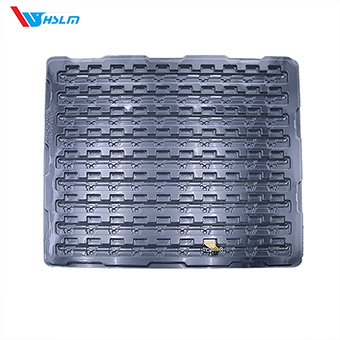
Circulation tray for industrial components. Shockproof, stackable, reusable and customizable for part turnover.
This circulation tray is specially designed for industrial components. Rigid plastic structure delivers good shock resistance, with independent molded cavities to separate parts and prevent abrasion during repeated turnover. Stable stackable design saves storage space, and customized sizes, cavity layouts and anti-static options are available to meet different industrial storage and transit needs.
- 1 Permanent & Stable ESD Protection
- 2 Precision CNC Tool-Molded Pockets
- 3 100K Cleanroom Certified Hygiene
- 4 High-Density Space-Saving Nesting
Industrial component circulation tray is part of our Thin-Gauge Precision Trays line. The series-level introduction, specifications, applications and FAQ below apply to this model and its related sizes. Custom specifications, materials and branding are available for bulk orders.
Product Overview & Market Intent
Semiconductor and consumer-electronics lines run industrial component circulation where a component has to stay aligned through pick-and-place, conveyor transfer and container shipping. Tolerances are held tight enough that the tray substitutes directly for the existing handling hardware.
More than twenty years of OEM and ODM thermoforming sit behind the production of these trays, which are moulded in a 100,000-class dust-free area. We work in anti-static, dissipative and conductive PS, PET and PVC, holding micro-tolerances so the parts integrate with the equipment that handles them.
Key Product Characteristics
For industrial component circulation in static-controlled assembly, permanent & Stable ESD Protection (Zero Electrostatic Risk): The anti-static properties are deeply embedded into the plastic sheet matrix, guaranteeing long-term stable resistivity (10^6 – 10^9 Ohm for dissipative or 10^3 – 10^5 Ohm for conductive) that won’t fade due to friction, washing, or environmental humidity changes.
Precision CNC Tool-Molded Pockets: Utilizing high-precision CNC tooling, each pocket/cavity is engineered with precise draft angles and tolerances, guaranteeing components stay snugly in place without friction damage while allowing rapid mechanical grabbing.
100K Cleanroom Certified Hygiene: Free from airborne dust, oils, or lint fibers, guaranteeing that sensitive electronic sensors, lenses, and acoustic parts are protected from microscopic surface contamination.
High-Density Space-Saving Nesting: Unloaded, these thin-walled trays nest without interruption together with minimum clearance, appreciably lowering warehouse storage footprint and reducing international ocean freight costs per unit.
For industrial component circulation in static-controlled assembly, hardware & Fine Instrument Storage: Serves as precision custom-slotted storage inserts for multi-part toolkits, micro-screws, and calibration tools in assembly bays. Commercial Applications & Scenarios Automated PCBA & Semiconductor Shipping: Serves as the standardized carrying tray matrix for raw circuit boards, microchips, and motherboard modules passing through high-speed SMT assembly lines. Consumer Electronics & Earphone Inner Liners: Tailored sleek black or custom-colored thin-gauge blister inserts used inside retail packaging for high-end earphones, smartwatches, and smartphone accessories to boost shelf presence. Fragile Medical Electronics Components: Provides secure, clean-room approved compartmentalized tray packaging for precision laboratory sensors and dental equipment pieces.
Technical Specifications
Technical Detail & Industrial Standard: Product Category
ESD Blister Trays / Thin-Gauge Electronic Packaging / Vacuum Formed Inserts: Material Formulation
High-Grade PS (Polystyrene), PET, PVC (Virgin Clear or Solid Matte Finishes): Material Thickness Range
Thin-Gauge Options: 0.5mm, 0.8mm, 1.0mm, to 1.5mm
Conductive: 10^3 – 10^5 Ohm | Dissipative: 10^6 – 10^9 \Ohm$ | Anti-Static: 10^9 – 10^{11} \Ome$
Production Environment: 100,000-Class Dust-Free Cleanroom Production Lines
Core Compliance: RoHS Compliant, REACH Certified, Lead-Free, SGS Laboratory Tested
Customization Capability: Full Custom CAD/3D Sample Engineering, Engraved Part Numbers & Logos
Global Industrial Case Study
The Client: A regional distributor facing rising freight costs.
The Challenge: The packaging in use nested poorly, so containers occupied far more container volume than the product required.
Our Solution: We reworked the nesting geometry so the empty units stacked with minimal clearance and re-specified the carton to match the revised stack height.
The Outcome: Freight volume per consignment fell, the customer reduced its container count on the same order volume, and the saving exceeded the tooling cost within the first season.
B2B Frequently Asked Questions
Q1: Do the anti-static properties of industrial component circulation fade with age or repeated washing?
A: No. The anti-static compound is blended into the sheet matrix rather than coated onto the surface, so the resistivity is a property of the material itself. Normal handling, stacking and cleaning do not strip it back.
Q2: Which surface resistivity band does industrial component circulation sit in?
A: For industrial component circulation the specification is set at the dissipative band, which is the usual choice for bare boards and populated assemblies that need protection without the discharge speed of a conductive tray.
Q3: Can industrial component circulation survive automated handling and repeated stacking cycles?
A: The wall is profiled with structural ribs and radiused corners, so the tray holds its geometry through repeated magazine loading. Cycle life depends on fill weight and nesting depth, and we recommend a pilot loop to establish the real figure for your duty cycle.
Q4: Can industrial component circulation be washed and returned to service?
A: Yes. The static-control compound is part of the sheet, so normal washing removes contamination without stripping the resistivity. We recommend a mild neutral cleaner and a full dry before the tray goes back into the line.